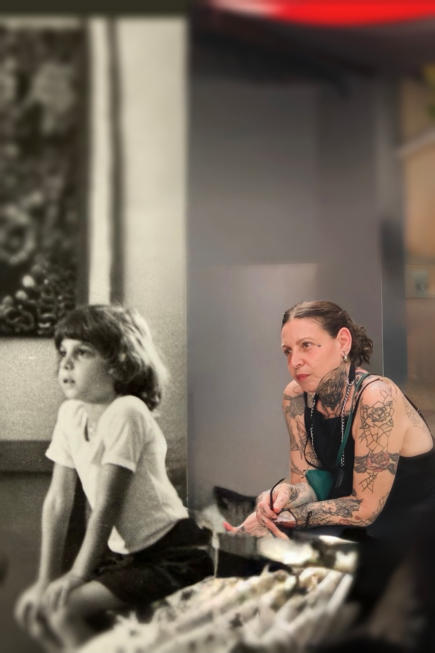
The Therapist as a Vehicle for Knowledge
Here, the therapist is not merely a neutral guide. They become a living embodiment of ancestral and contemporary
knowledge, representing the convergence of matriarchal traditions, symbolic rituals, and contemporary
psychoanalytic scholarship.
Their life journey, personal experiences, and confrontations with social norms serve as a vehicle for knowledge and
transformation.
The traumas and resilience of past generations, transmitted consciously or unconsciously, intertwine with academic
knowledge and lived experience.
The therapist thus becomes a conduit, a repository of memory, and a catalyst; they embody transgenerational and
contemporary knowledge, enabling patients to encounter a healing experience that is at once historical, symbolic,
and deeply relevant to the present.
Each session becomes a living laboratory where the psychological, the social, and the symbolic interact within an
experiential continuum.
Lorène E.z. Abfayer
Therapist and psychoanalyst.
Lorène E.z. Abfayer is a non-binary queer therapist and psychoanalyst. They develop a situated practice that claims
neither neutrality nor objectivity.
In Queertherapie, the therapist is not merely a guide: they are a committed presence, shaped by stories, ruptures, and
forms of resistance. Their practice is built upon these lines of tension.
As a non-binary, LGBTQ+ person whose journey has unfolded across different countries and cultural contexts,
Lorène E.z. Abfayer is a multifaceted therapist whose travels have opened up spaces for encounters with diverse
LGBTQ+ communities and with ways of life that escape, circumvent, or subvert dominant norms.
Their existence in a heteronormative world is not merely a context; it is a formative experience, a living substance
that shapes the way they listen, understand, and support others.
Trained in psychoanalysis at the EFPP and specializing in the understanding of trauma through the teachings of Dr.
Gabor Maté, Lorène E.z. Abfayer integrates this framework with contemporary critical perspectives, as well as an
attention to the symbolic and transgenerational dimensions of lived experiences.
They do not offer a space for normalization. They open a space where norms can be questioned, shifted, and
sometimes even rejected.
In this work, individual experiences are never isolated; they are interwoven with collective histories, legacies,
violence, and forms of resistance.
The therapist’s own journey is not set aside in favor of a supposedly neutral stance. Instead, it is consciously drawn
upon — as a tool, as a memory, and as a point of support in the therapeutic process.
Queertherapie supports people across the entire spectrum of sexual and gender identities, whether they are in the
process of forming, shifting, questioning, or experiencing tension.
Each session is a space where something can shift, take shape, or change — a meaning, a place, a way of being.
Here, therapy does not aim for adaptation; rather, it opens up the possibility for other forms of self-understanding.

© Lorene Abfayer and Alexis Neel

The Therapist as a
Vehicle for Knowledge
Here, the therapist is not merely a neutral guide.
They become a living embodiment of ancestral
and contemporary knowledge, representing the
convergence of matriarchal traditions, symbolic
rituals, and contemporary psychoanalytic
scholarship.
Their life journey, personal experiences, and
confrontations with social norms serve as a
vehicle for knowledge and transformation.
The traumas and resilience of past generations,
transmitted consciously or unconsciously,
intertwine with academic knowledge and lived
experience.
The therapist thus becomes a conduit, a
repository of memory, and a catalyst; they
embody transgenerational and contemporary
knowledge, enabling patients to encounter a
healing experience that is at once historical,
symbolic, and deeply relevant to the present.
Each session becomes a living laboratory where
the psychological, the social, and the symbolic
interact within an experiential continuum.
Lorène E.z. Abfayer
Therapist and psychoanalyst.
Lorène E.z. Abfayer is a non-binary queer
therapist and psychoanalyst. They develop a
situated practice that claims neither neutrality
nor objectivity.
In Queertherapie, the therapist is not merely a
guide: they are a committed presence, shaped by
stories, ruptures, and forms of resistance. Their
practice is built upon these lines of tension.
As a non-binary, LGBTQ+ person whose
journey has unfolded across different countries
and cultural contexts, Lorène E.z. Abfayer is a
multifaceted therapist whose travels have
opened up spaces for encounters with diverse
LGBTQ+ communities and with ways of life
that escape, circumvent, or subvert dominant
norms.
Their existence in a heteronormative world is
not merely a context; it is a formative
experience, a living substance that shapes the
way they listen, understand, and support others.
Trained in psychoanalysis at the EFPP and
specializing in the understanding of trauma
through the teachings of Dr. Gabor Maté,
Lorène E.z. Abfayer integrates this framework
with contemporary critical perspectives, as well
as an attention to the symbolic and
transgenerational dimensions of lived
experiences.
They do not offer a space for normalization.
They open a space where norms can be
questioned, shifted, and sometimes even
rejected.
In this work, individual experiences are never
isolated; they are interwoven with collective
histories, legacies, violence, and forms of
resistance.
The therapist’s own journey is not set aside in
favor of a supposedly neutral stance. Instead, it
is consciously drawn upon — as a tool, as a
memory, and as a point of support in the
therapeutic process.
Queertherapie supports people across the entire
spectrum of sexual and gender identities,
whether they are in the process of forming,
shifting, questioning, or experiencing tension.
Each session is a space where something can
shift, take shape, or change — a meaning, a
place, a way of being.
Here, therapy does not aim for adaptation;
rather, it opens up the possibility for other forms
of self-understanding.
© Lorene Abfayer and Alexis Neel