Queertherapie is constantly evolving.
From this perspective: everything is in flux; gender, sexuality, and the “self” are not fixed, they are
continually constructed, reenacted, and transformed.
Since identity is fluid, a rigid form of therapy becomes inadequate. Unlike traditional normative
approaches, Queertherapie holds that the meaning of the self, of lived experience, and of trauma is not
merely discovered but co-constructed between therapist and client.
This principle aligns with a framework close to social constructionism, influenced by thinkers such as
Michel Foucault, in which norms and knowledge are produced by social and historical contexts.
Therapy must therefore evolve alongside narratives, contexts, and power dynamics.
Queertherapie does not aim solely at individual well-being but also contributes to a broader transformation
of collective well-being. Indeed, by challenging dominant norms related to gender, sexualities, and the
validity of bodies, Queertherapie opens up spaces where other ways of existing become possible,
legitimate, and livable.
This approach goes beyond personal support; it challenges the social mechanisms that produce exclusion,
shame, isolation, or violence.
Heterosexuality viewed as the sole norm, as well as ableist representations of bodies and abilities, have
tangible effects on mental health, social relationships, and a sense of belonging.
By working to deconstruct these norms, Queertherapie helps create more welcoming, safer, and more
inclusive environments, not only for queer, trans, disabled, or marginalized people, but for society as a whole.
Challenging rigid norms also broadens the possibilities for life, expression, and relationships for everyone.
Collective well-being is thus built through a culture of listening, self-determination, and recognition
of diverse lived experiences. This approach affirms that mental and emotional health cannot be understood
independently of the social, political, and cultural contexts in which individuals live.
Thus, Queertherapie views care as a practice that is both intimate and collective, caring for individuals
while helping to transform the structures that hinder their fulfillment.
We often experience rapidly changing realities, new forms of self-identification, linguistic shifts, and
social and political transformations. A dynamic practice allows us to integrate these changes, understand
them structurally, and work through them in a safe, supportive, activist, and depathologizing space.
Change, in this context, is not a choice but an ethical necessity.


Living Practice
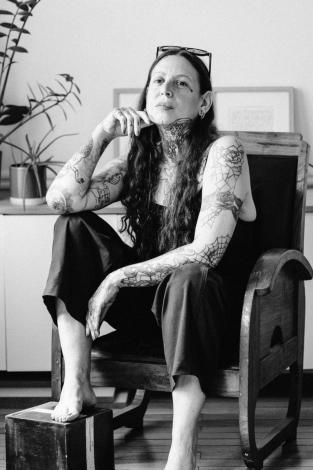
Lorène E. z Abfayer “Ezræla” 2026.
Photo @ Angela di Paolo

A subjective mapping of the territories that make up an ancestral heritage.
Queertherapie is constantly evolving.
From this perspective: everything is in flux;
gender, sexuality, and the “self” are not fixed,
they are continually constructed, reenacted, and
transformed.
Since identity is fluid, a rigid form of therapy
becomes inadequate. Unlike traditional
normative approaches, Queertherapie holds that
the meaning of the self, of lived experience, and
of trauma is not merely discovered but co-
constructed between therapist and client.
This principle aligns with a framework close to
social constructionism, influenced by thinkers
such as Michel Foucault, in which norms and
knowledge are produced by social and historical
contexts. Therapy must therefore evolve
alongside narratives, contexts, and power
dynamics.
Queertherapie does not aim solely at individual
well-being but also contributes to a broader
transformation of collective well-being. Indeed,
by challenging dominant norms related to
gender, sexualities, and the validity of bodies,
Queertherapie opens up spaces where other
ways of existing become possible, legitimate,
and livable.
This approach goes beyond personal support; it
challenges the social mechanisms that produce
exclusion, shame, isolation, or violence.
Heterosexuality viewed as the sole norm, as
well as ableist representations of bodies and
abilities, have tangible effects on mental health,
social relationships, and a sense of belonging.
By working to deconstruct these norms,
Queertherapie helps create more welcoming,
safer, and more inclusive environments—not
only for queer, trans, disabled, or marginalized
people, but for society as a whole.
Challenging rigid norms also broadens the
possibilities for life, expression, and
relationships for everyone.
Collective well-being is thus built through a
culture of listening, self-determination, and
recognition of diverse lived experiences. This
approach affirms that mental and emotional
health cannot be understood independently of
the social, political, and cultural contexts in
which individuals live.
Thus, Queertherapie views care as a practice
that is both intimate and collective, caring for
individuals while helping to transform the
structures that hinder their fulfillment.
We often experience rapidly changing realities,
new forms of self-identification, linguistic
shifts, and social and political transformations.
A dynamic practice allows us to integrate these
changes, understand them structurally, and work
through them in a safe, supportive, activist, and
depathologizing space.
Change, in this context, is not a choice but an
ethical necessity.

Living Practice
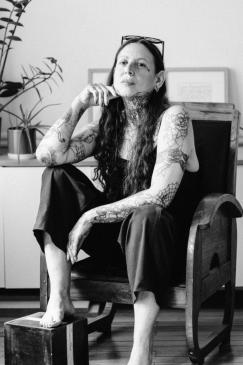
Lorène E. z Abfayer “Ezræla” 2026.
Photo @ Angela di Paolo
A subjective mapping of the territories that make up an ancestral heritage.